
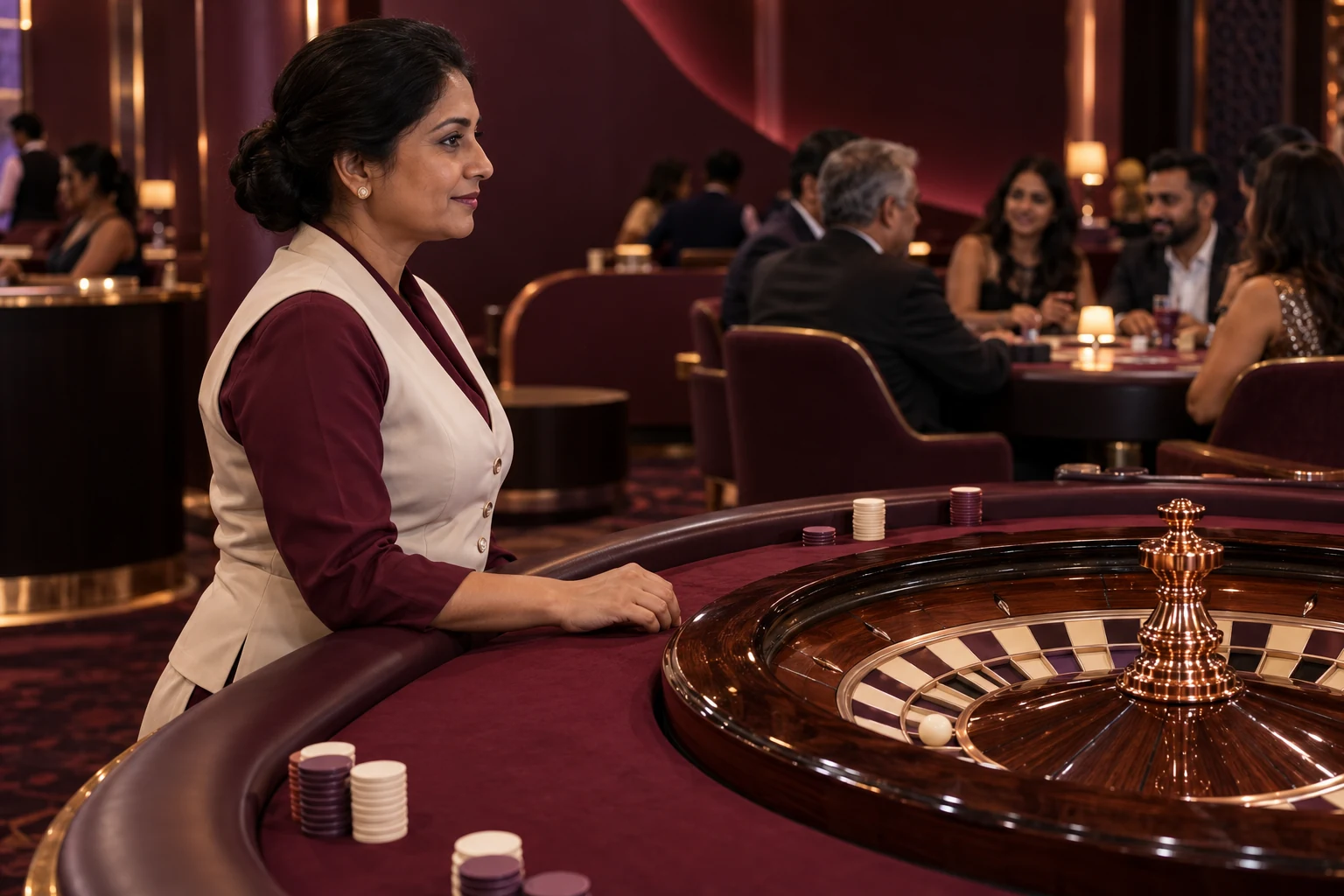

Game reference
D Roulette
A roulette title credited to SA Gaming in the external Jackpotter catalogue.
Provider named in the source catalogue: SA Gaming.
Source: Jackpotter game catalogue.
Read the source version’s current rules. This reference does not establish availability, game configuration or payout terms for another service.
Return to the game collection →12BET’s published profile describes an India-focused casino and sportsbook. The sportsbook side is represented by cricket; the casino side names slots, Teen Patti, Andar Bahar and live dealer games. The same profile lists fast UPI deposits, INR support and mobile play, and carries an 18+ restriction with terms and conditions applying. A separate listed bonus offer states a ₹20,000 bonus plus 100 free spins, subject to the same 18+ and T&C conditions. Brand and offer claims in this feature come from that published profile; the named table titles discussed below are independently sourced examples from external catalogue entries, not a checked current 12BET game inventory.
Jackpotter’s live-casino category defines its subject as games presented by real dealers, and it separates live Blackjack, live Roulette, live Baccarat, live Poker and game-show formats into distinct groupings. That is a useful organising principle because the presentation layer and the underlying game are different things. A real dealer is a person conducting the game; the rules that decide the result belong to the game family. The same category page lists game-show formats beside the classic tables, which shows how broad the presentation label can be.
The companion table-games category adds a second layer. It names Blackjack, Baccarat, Poker, Roulette and Craps as table-game families, and it notes that the category includes both automated or virtual tables and games with live dealers. Read the two pages together and the classification becomes clear: the table-game family is the broader grouping, and the live-dealer treatment is one way of presenting a member of that family. Blackjack belongs to the family whether a dealer is shuffling or a computer is dealing; roulette belongs to it whether the wheel is physical or simulated. For an India-facing brand, that distinction matters because the live-dealer category sits alongside slots and the two Indian card forms rather than replacing them.
12BET live casino in an India-facing brand profile
The profile’s combination of cricket, slots, Teen Patti, Andar Bahar and live dealer games describes a mixed portfolio. INR support gives the service an Indian-rupee currency context, and fast UPI deposits are a listed payment feature. Mobile play is also listed as a brand feature. Together, these details describe how 12BET frames its casino and sportsbook for Indian players.
Blackjack by Smartbet: card totals and the dealer’s hand
The Jackpotter entry for Blackjack carries the provider label Smartbet directly beneath the title. This exact product identity sits alongside the following independently documented blackjack conventions.
Those general conventions are documented separately. A PlayWSOP blackjack article sets out ordinary card values: numbered cards keep their number, picture cards count as ten, and an ace can count as either one or eleven. It distinguishes a two-card natural blackjack from a total of twenty-one assembled across more cards, and it defines a push as a tied player and dealer total. These are general blackjack conventions, attributed to that independent explanation rather than to the Smartbet product.
The same article describes an interface example that separates a player hand area, a dealer area and an action log. The arithmetic is central to blackjack: values are added, an ace may be read two ways, and player and dealer totals are compared. A viewer watching a live blackjack table is watching cards whose values contribute to a hand total, and the dealer’s visible cards are part of the same comparison.
Card identity versus wheel identity
Blackjack is built on individual card identity. A seven is worth seven, a king is worth ten, and the ace carries its dual value. The table’s visual language is therefore dominated by card placement and by the relationship between the player’s cards and the dealer’s. Roulette has no equivalent: the resting pocket supplies a number and colour, and the wheel’s pockets carry the result. That difference in resolution shapes what a viewer watches. Blackjack displays cards whose values contribute to a hand total; roulette centres on the wheel and the number at which the ball comes to rest. Cards and numbered wheel segments therefore supply different visual reference points, and a live dealer’s role differs accordingly: in blackjack the dealer distributes and reveals cards, while in roulette the dealer oversees the spin and the layout.
D Roulette by SA Gaming: wheel resolution
The Jackpotter entry for D Roulette carries the provider label SA Gaming. The catalogue establishes that title and provider identity. Roulette as a family resolves a round through a spinning wheel and a numbered layout. The visual identity is circular and colour-coded: a segmented wheel, a grid of numbers, and the marked areas where positions are recorded. A reader looking at a roulette thumbnail is reading a wheel, not a hand.
Roulette variants can use different wheel configurations. A separate Jackpotter page for Classic Roulette, labelled Playtech, describes a European wheel with thirty-seven pockets and a single green zero. This is a separate title from D Roulette. The same page describes a chip selector, a bet layout, hot-and-cold number indicators, history tracking and replays; those are features of that published Playtech example, not evidence about the SA Gaming product.
Card, wheel and the wider live category
Set the two headline titles side by side and the live-casino category’s internal variety becomes obvious. The two named references introduce different game families. General blackjack conventions describe totals and the dual value of an ace; the roulette family centres on a wheel and a numbered result. Live presentation is a separate category distinction from those underlying forms. The category also lists live Baccarat, live Poker and game-show formats, which are separate headings within the dealer-presented category rather than variations on a single mechanic.
The Andar Bahar entry, labelled KA Gaming, shows how far the range extends. Andar Bahar as a family centres on an initial house or joker card and subsequent cards dealt to two named sides, Andar and Bahar, with a matching card identifying the side tied to the round result, as described in Evolution’s publisher background definition. That is a card game, but its structure is neither blackjack’s accumulation nor roulette’s spin. The 100 Teen Patti entry, labelled Rich88, belongs to a three-card-hand family in which three-card poker hands are compared, per Evolution’s separate publisher background definition. Evolution’s separate Teen Patti example compares a player’s three-card hand with a dealer’s three-card hand.
An independent social-poker comparison
One further comparison shows how varied card games can be. PlayWSOP, a separate social-poker product intended for adults aged twenty-one and over for amusement, describes Texas Hold’em as combining two private hole cards with a shared board of up to five community cards, revealed as a flop of three, then a turn, then a river. The ranked result is a five-card hand drawn from the private and shared cards. Its browser game uses virtual chips, and play does not award real money or real prizes. That private-and-shared structure differs from blackjack, where each hand stands on its own cards. Hold’em spreads cards across the table, which changes what a viewer has to track. The board always contributes at least three cards to the best five, since zero, one or two hole cards imply five, four or three community cards respectively, and equal-strength hands tie rather than producing a single winner merely because the board holds the best five.
Game artwork and catalogue sources